How to Dox Anyone
Liz Fong-Jones, litigious transgender millionaire, knows where you live.

Finding someone’s personally identifying information usually involves that person first making a mistake: creating public posts that can be cross-referenced with public records. Someone with perfect privacy practices could not be ‘doxed’ this way.
It is no longer possible to stay anonymous from a dedicated adversary. Liz Fong-Jones, an ex-Google tech millionaire and trans activist, has figured out how to dox anyone who posts online simply by filing a form.
Who is Liz Fong-Jones?
Liz Fong-Jones is a former Google employee who is now a fellow with Honeycomb, a tech startup so large it has direct relations with Anthropic, GCP, Azure, and other billion-dollar platforms.
In 2019, Liz Fong-Jones was accused of sexual assault and took to Twitter to pen a defense. In short, Jones minimizes the accusations as a simple “consent accident”: a ridiculous misunderstanding over dog hair. The original victim’s statements have disappeared from the Internet. Coincidentally, Jones is a master of Internet censorship. The Kiwi Farms is the only place that hosts critical information against Liz Fong-Jones, which is why Jones has been dedicated to bringing down the site for almost a full decade.
After failing for years, Liz Fong-Jones switched tactics: Sue everyone.
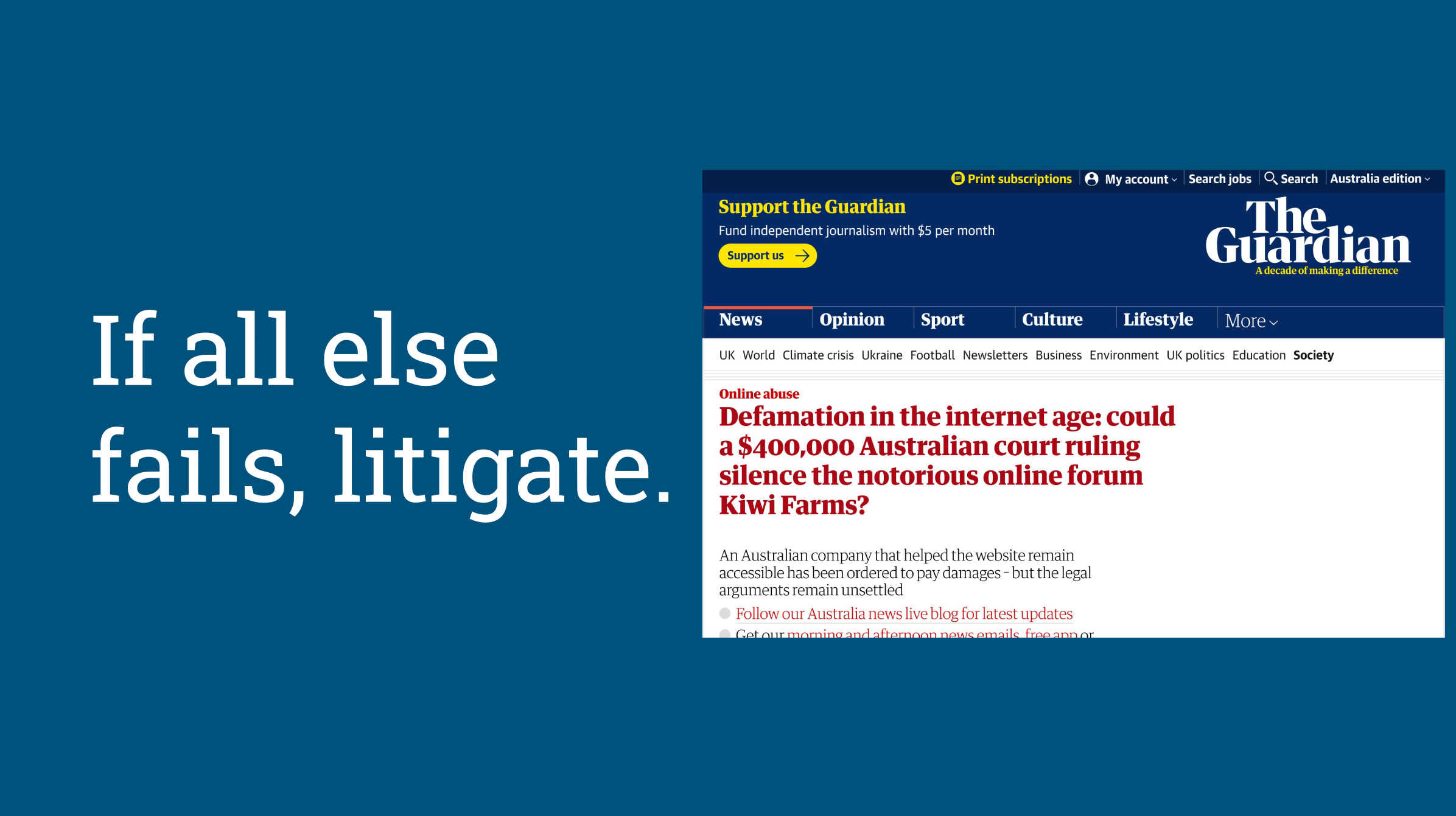
Five years of history in two sentences: Liz Fong-Jones engaged in a campaign of litigious aggression against people with no direct association to my website, attacked Internet infrastructure by directly contacting the executives of the largest ISPs in the world, and achieved provider-level censorship that the free Internet has never seen prior. We still found ways to stay online.
Liz Fong-Jones is a sadistic and intelligent psychopath. He is obsessed with meticulously curating his Internet reputation. At best, he has total disregard for the freedom and well-being of others. At worst, he simply enjoys torturing people of modest means through costly litigation because they’ve ever dared to say a cross word about him on the Internet, or just for being friends with someone who has.
On Jun 25, 2026, Liz Fong-Jones has filed a DMCA lawsuit against 10 John Does, claiming that fair use edits of his social media profile deprived him of his rights. These images ranged from critically transformative text overlays about the “consent accident”, to highly reconstructive AI parodies, to MS paint drawings that stayed up for only about an hour. The point is not the copyright, nor any ‘financial harm’: it’s about doxing people. By the time you’re arguing “fair use” in court, you’re already doxed and have spent tens of thousands of dollars; you’ve already lost.
To that end, Liz Fong-Jones hired an entire lawfirm (KUSK: Kamerman, Uncyk, Soniker & Klein) to perfect a strategy I will now give you for free. Here’s how to dox anyone.
The Liz Fong-Jones Method
DMCA Section 512(h) provides a pre-litigation subpoena process for acquiring subscriber information from any1 service provider in the United States, or anywhere that might honor an American court order. These are proper orders from the Court with the full force and power of the United States Federal Government behind them. They cannot be ignored.
These instructions are for educational purposes. Do not break the law or defraud the Court. I am not an attorney and this is not legal advice. Read the law: 17 U.S. Code § 512.
Find a service that your target posts on.
Issue a DMCA § 512(c)(3) takedown notice. This is a formal copyright complaint.
Prepare the following documents. AI can generate these.
A request to the clerk to issue the subpoena.
A proposed subpoena (Form AO 88B or a court-specific template), directed to the service provider, ordering them to disclose identifying information about the alleged infringer “sufficient for the copyright owner to pursue their rights” (i.e. dox to find them and serve them a lawsuit).
A copy of the § 512(c)(3) notification (or a statement that one was sent).
Include a sworn declaration stating the subpoena will only be used to protect your 17 U.S.C. § 512 rights (copyright only, not defamation).
File with the clerk of any U.S. District Court.
Pay the filing fee. The standard fee is $49.
Wait for it to be granted. The 512(h) provides no sanity checks. The Court will almost always grant it. Northern District of California prints these routinely.
Send the subpoena to the service provider.
Wait for the dox. It’s coming to you on a silver platter. Almost no service provider will pay for lawyers to defend some random guy’s personal information.
That’s all. Unless the target has maintained opsec so good that the U.S. Federal Government wouldn’t be able to subpoena their way to finding them, you can use this mechanism to dox anyone.
Yes, it’s that easy.
“Won’t the Court check that my request makes sense?”
No. There are no sanity checks. The § 512(h) subpoena issues ministerially: the Clerk has no statutory power to review even the factual basis of your request. All cases involving quashing a § 512(h) subpoena are done after the issuance (named as In re: Reddit).
Our Court works on the honor system. It’s designed to be this way because the MPAA/RIAA owns the Congress. Nobody gives a fuck. We’re all on our own.
“Don’t you have to file a lawsuit?”
No. DMCA § 512(h) is a pre-litigation administrative tool. You cannot sue someone you cannot serve a lawsuit on, and that requires knowing who they are. To let rights-holders sue anonymous people on the Internet, the Congress in the 1990s wrote into the DMCA a way to dox anyone. It exists specifically to get information before any lawsuit is filed. There is no requirement you follow through.
“How do I file a 512(c)(3) takedown notice?”
You simply need to fill in a form (or have AI generate) a notice that comports to DMCA § 512(c)(3)(A). In essence, all you need is two links, your email address, and a sentence saying “I swear that everything here is true, I’m authorized to represent this copyright, and I have a good-faith belief my rights are being infringed.” Sign and send.
The correct person to send it to is their DMCA agent, which can only be found on the copyright.gov DMCA agent directory. Any other copyright process on their site is not the 512(c)(3) point of contact and exists to cause confusion (the YouTube and Google copyright forms are all designed to misdirect you into filing complaints that are not legally enforceable, as they are not the statutory DMCA takedown system).
If they haven’t registered an agent, they don’t enjoy § 512(c) safe harbor provisions at all, which is bad for them. Just email anyone you can find in that instance.
“How long does this take?”
You can file a takedown notice and request a subpoena the same day. You do not need the target to counter-DMCA. You do not have to wait for a response to your notice; there is no need to wait any length of time at all. You may immediately request a subpoena from the Court after sending the notice.
Northern District of California grants these subpoenas so regularly that if you file on a Monday you will almost certainly get your subpoena by Wednesday.
Once you have it, the response time is flexible (language is “expeditiously disclose”). Big companies have a formal subpoena intake process that is 1-4 weeks. Smaller providers may be faster.
“Can’t the provider refuse?”
Yes, but they won’t. In the Kiwi Farms case, I have moved to quash the subpoena with our attorney. This is a very unusual and expensive step. As long as the DMCA looks like it could be legitimate, and the target isn’t very high-profile, they will not ask questions.
“Will the target know I did this”
Yes. § 512(g) describes the take-down and replacement process. When the provider receives your § 512(c)(3) notice, they will forward a copy of everything you sent to the author of the posts you are claiming. This will provide them the opportunity to contest the take-down.
Since you can file a § 512(h) subpoena with the Court immediately after sending the § 512(c)(3) notice, you can probably get a subpoena from the Clerk before they even get notified about the copyright complaint.
While § 512(g) notifies them of the take-down request, nothing notifies them about the subpoena. It’s also a toss-up if the provider who receives the subpoena will notify the target of this; there is no legal requirement that either the Court or the provider do so. There is no way to quash a subpoena you’re not informed about.
What’s also funny is that while § 512(g)(3) says to file a counter-notification they basically have to dox themselves to you anyways. The average person responding will have no idea you get their contact information and will use their own information instead of a corporate shell. This means you don’t even have to go through with the subpoena process, it frequently happens that someone will just accidentally dox themselves in their counter-notification.
Of course, for a foreign criminal lying to the Court, there’s no notice at all. They just get the subpoena without sending anything.
“Why haven’t people figured this out before?”
They have. IP rights holders use it routinely and have since the 1990s. A few fringe psychos have tried it in the past. What’s new is that a tech millionaire and trans advocate, Liz Fong-Jones, is using it to target an entire community of tens of thousands of people for the sole purpose of upending their constitutional rights.
“Won’t I get in trouble?”
Maybe. You have to swear under penalty of perjury, twice, that what you are doing is in good faith. However, the bar for proving bad faith is very high. If there’s any reason you might have thought your rights were being infringed, you are probably safe.
Examples:
Screenshots or reproductions of your articles or posts.
Copies or edits of images you took.
Sharing or remixing your music or spoken word audio.
Clips or parodies of a video you made.
Anything else that can be considered your copyright being shared in any form.
Remember, you don’t have to win anything. You’re not actually going to Court. You’re just trying to state you have a good-faith belief you were entitled to take down a post and issue a § 512(h) subpoena. That bar can be met just by being stupid and wrong.
The whole point of this mechanism is you don’t have to sue anyone. That is very expensive. For your target to even retain a lawyer, they are spending $5000 after-the-fact just to complain you already got away with something for $49.
To try and say you acted in bad faith, they have to sue you. By that point, the damage is already done and you already have their information. They can’t un-dox themselves; genies do not go back in bottles.
“Do I have to be an American, be a lawyer, or hire a lawyer?”
No. You can file pro se from anywhere in the world. The Nothern District of California will allow you to e-file from outside the country representing yourself.
The Fix
The only thing that can fix the DMCA is Congress. That won’t happen.
Let’s play pretend and assume Congress is a functional institution that gives a shit about you (they don’t). Here’s what they could do.
Add strict liabilities to § 512(h) abuse with statutory damages. They could also add better protections against take-down notice abuse in general. Currently, there is no protections for victims of DMCA abuse. The one safeguard is § 512(f), which only applies to the § 512(c)(3) notice, requires knowingly false statements (not just being wrong and stupid), and is almost never awarded.
Require a Complaint to be filed and some attempt at normal service of process before allowing the § 512(h). There are currently zero safeguards or sanity checks.
Add safeguards to pro se filing and PACER in general. Right now there’s nothing stopping anyone from filing bogus lawsuits under false names. Someone from China could e-file a lawsuit against you for something heinous like child abuse using a completely AI-generated complaint and a totally fictitious story, ruin your life, force you to pay thousands to fight the lawsuit, and suffer no repercussions.
That’s all it would take.
Technically, you must serve an OSP (Online Service Provider, i.e. YouTube), not a ‘mere conduit’ ISP (Internet Service Provider, i.e. Cox). In reality, you can request whatever you want. It’s up to the service provider to care.